
Horror directors and producers save up their best shit to release around this time of year, and two incredible documentaries just dropped. Documentaries about horror are like, the film version of my work and a whole window into my brain and I love them very much. I’ve written about cursed films, queer horror,and horror noire, and if you’re looking for some inspo this season definitely check some of those out.
This year, I watched The Vampires of New Orleans and Black Zombie, two excellent new documentaries that have so much more in common than I expected. Vampires and zombies are, at their core, revenants. Revenants are the undead, and many cultures have folklore about people coming back from the grave. Depending on the place and its specific fears, different types of revenants can show up in their folklore. Vampires and Black Zombie explore these histories and trace the evolution of the vampire from a rotting, incestuous dead peasant to sparkly sexy aristocrat and the zombie from a vodou-adjacent sorcerer’s creation symbolizing slavery to a fast moving brain eater. Would you believe me if I told you that SLAVERY was at the center of both of these creatures?? Woke 3.0 is here and I’m your professor! Get out your pronouns, class!
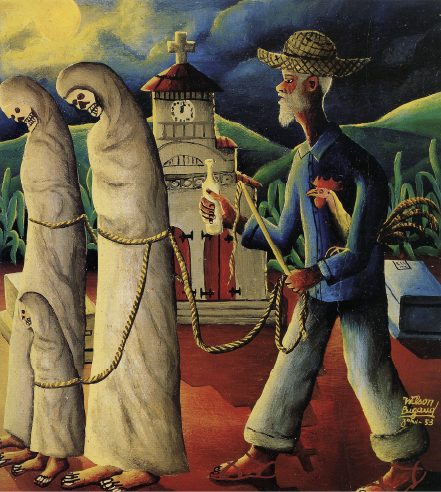
Wilson Bigaud (Haitian, 1931 – 2010) oil on board mounted on wood panel. Source: Haitian Art Society
Vampires of New Orleans
Nowadays, everyone associates vampires with New Orleans, but does the legend go deeper than Anne Rice? Vampires of New Orleans is trying to find out, but in a delightfully deranged way. I assumed that this was going to be a regular documentary, but it’s actually something new: part doc, part super camp low budget horror movie. People on Letterboxd are calling it “hybrid horror,” which I think we should cosign. I love the concept – on first watch it was a little schlocky for me but then when I went back to take notes I better understood the framework, and I really appreciated it. It’s a cool experiment and I learned a lot about the folklore and deeper implications of the idea of vampires in the culture down there. And for folks who get bored watching talking heads (occultists, writers, ghost tour operators – THEY WERE ALL GREAT), the campy horror is a good distraction. The movie looks into different kinds of vampire ideology (for lack of a better word) in New Orleans. There are lifestyle vampires, which are run of the mill weirdos that live everywhere but really seem attracted to New Orleans – especially after Anne Rice. They’re mostly into blood play and fanfic, and there’s a lot of overlap with queerness. Then there are the people who sincerely believe in vampires, who are ghost story nuts and ghost tour devotees who take the lore seriously. I mean, it’s good for business down there. All of these folks mix with regular ass local goths, who seem to tolerate them. The film’s main concern is “why New Orleans?” I don’t want to give away the story but it’s not just Anne Rice. Louisiana’s lore is heavily inflected with ideas of the Southern Gothic, a genre of fiction and storytelling that uses horror to explore ideas of slavery, violence, and repression. The trauma of the Lost Cause myth and the immense suffering under slavery and Jim Crow can show up in folklore, and what better metaphor for an enslaver, or a system of enslavement, than a vampire? An undying creature that drains the lifeblood of other humans to fuel their power?Black Zombie
In Black Zombie, we learn how that metaphor works on the flip side – how a person brought back from the dead to toil for eternity with no soul symbolizes life under slavery. Black Zombie takes us to Haiti, where the concept originated, and shows us how American occupation brought it to the US. The documentary shows us that although zombies are a staple of modern American horror, most of us have no idea about their Haitian roots. Haiti was once France’s most prosperous colony. It was called the “Pearl of the Antilles” because it generated massive amounts of wealth for French slave owners. Life for the enslaved, of course, was hideously brutal. Enslaved people were treated as commodities to be worked to death and replaced before their bodies hit the ground. White enslavers employed fear and brutality to try to discourage organizing and revolt – they were seriously outnumbered – but it didn’t work. In 1798, Black Haitians took the concepts of Liberté, égalité, and fraternité back, and beat the bricks off of Napoleon’s French government. In fact, the Haitian Revolution was the first and only successful slave revolt in the Americas. Legend has it that the bloody battle was kicked off by a vodou ritual, starting plenty of racist rumors blaming black magic and sorcery for the Empire’s defeat. My personal theory about the deeply racist, disgusting rhetoric about Haitians that continues to plague the US today is that we’re afraid of the people who threw off the European yoke. Here in America we thought we were special like that. That hasn’t stopped us from meddling in Haiti’s affairs since the beginning. The US occupied that part of the island from 1915 to 1934, kicking off a century of problematic involvement that also included propping up dictators and spreading cholera to the earthquake-ravaged population. While the Marines were there, they exploited ideas about vodou and sorcery to control people and source labor. They took a page out of American convict leasing and banned the practice of vodou, then used that ban as a pretext to arrest people and put them to work on chain gangs called corvees. In other words, they also used slave labor. Zombies are both a vodou-adjacent concept and a metaphor for the condition of slavery. It’s not a stretch to understand it, a zombie is a creature that is woken from the dead and forced to labor – endlessly, soullessly, for eternity. Being under a spell, under the control of a sorcerer, is the same as being enslaved by a white French “owner.” Black Zombie traces its evolution in American popular culture – starting with White Zombie in 1929 (you can watch this on YouTube!) all the way to Walking Dead and the Last of Us The earliest American depictions are shot through with racist tropes about savage islanders, but as they evolve the Haitian origins of the zombie disappear. I wanted to scream about history but I also don’t want to spoil the movie, so go watch it on Apple+. It’s incredible and it has a 100% on Rotten Tomatoes. Halloween time is REVENANT TIME so go forth and enjoy your undead with this new critical understanding. You earned that snickers, bb.SOURCES:
Gangsters of Capitalism by Jonathan Katz
Undead Uprising: Haiti, Horror, and the Zombie Complex by John Cussans
Revolutions Podcast: Haitian Revolution
Exhumed: Unearthing the History of the American Vampire by Aaron Mahnke
Voodoo, Torture, and Pirates: New Orleans History History Revealed – NatGeo on Youtube
Killing the Dead – Vampire Epidemics from Mesopotamia to the New World by John Blair